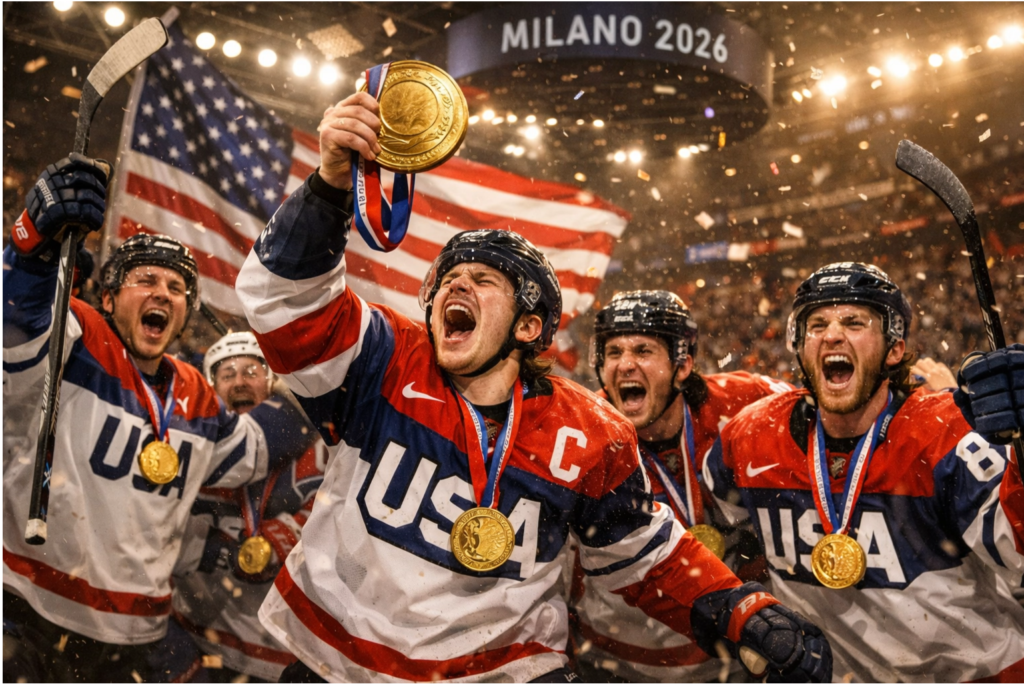
Miracle on Ice 2.0: The date was February 22, 2026. The setting was the PalaItalia Santa Giulia in Milan, Italy. As the final buzzer echoed through the arena and the red, white, and blue jerseys swarmed the ice in a frenzied celebration, the ghost of 1980 was finally laid to rest. For forty-six years, American hockey fans had lived in the shadow of the “Miracle on Ice,” a singular moment of sporting perfection that seemed impossible to replicate. But in the thin, electric air of the Milano Cortina Winter Olympics, a new generation of heroes etched their names into history.
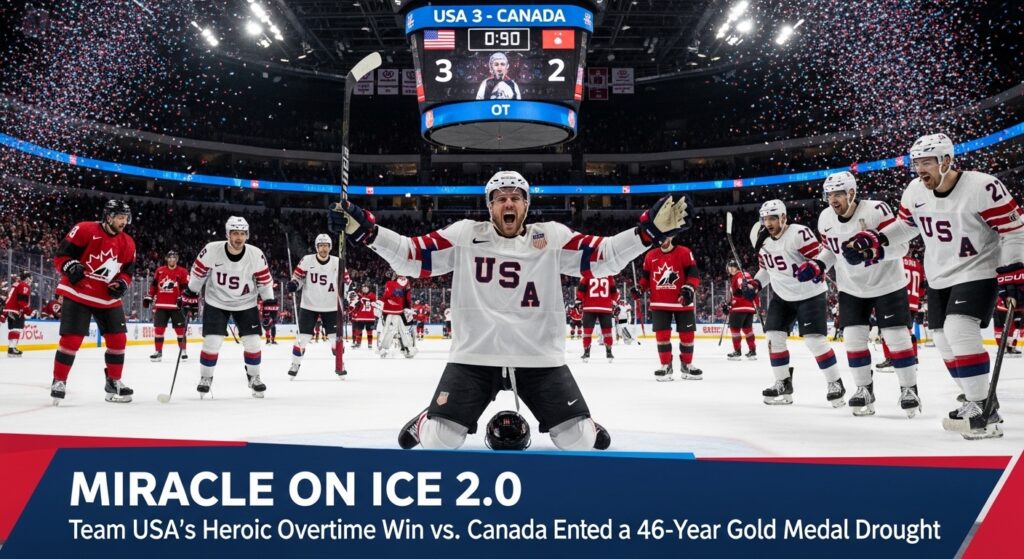
In a game that will be whispered about in locker rooms for decades, Team USA defeated arch-rival Canada 2-1 in a heart-stopping overtime thriller to claim the Olympic gold medal. It wasn’t just a victory; it was a exorcism of nearly half a century of “what-ifs” and “almosts.” This was the “Miracle on Ice 2.0,” a best-on-best clash that proved the United States is no longer just a challenger in the world of hockey—it is the standard.
The Weight of 46 Years
To understand the magnitude of this victory, one must understand the burden this team carried. Since Mike Eruzione’s legendary goal in Lake Placid in 1980, the United States had reached the gold medal game twice—in 2002 and 2010—only to fall to Canada both times. For forty-six years, the U.S. had produced world-class talent, from Mike Modano to Patrick Kane, yet the ultimate prize remained elusive.
The 2026 Olympics represented the first time since 2014 that NHL players were permitted to participate, making this the most anticipated hockey tournament in history. The world’s greatest players—McDavid, Matthews, MacKinnon, Hughes—were all on the same ice, representing their flags. For Team USA, the mission was clear: end the drought, or remain a footnote in the shadow of the 1980 squad.
The Road to Milan: A Collision Course
From the opening puck drop of the tournament, it felt as though USA and Canada were destined to meet in the final. Team USA, led by head coach John Hynes and a leadership group featuring Auston Matthews and Quinn Hughes, tore through the group stage with a blend of speed and defensive discipline that left opponents gasping.
Canada, meanwhile, entered as the heavy favorites. With a roster that looked like a first-ballot Hall of Fame induction ceremony—headlined by Connor McDavid, Nathan MacKinnon, and the young phenom Connor Bedard—they were expected to steamroll the competition. Their path to the final was a display of offensive firepower, but as they reached the gold medal game, they met a U.S. team that had built a literal wall in front of their net.
The Game: A Masterclass in Tension
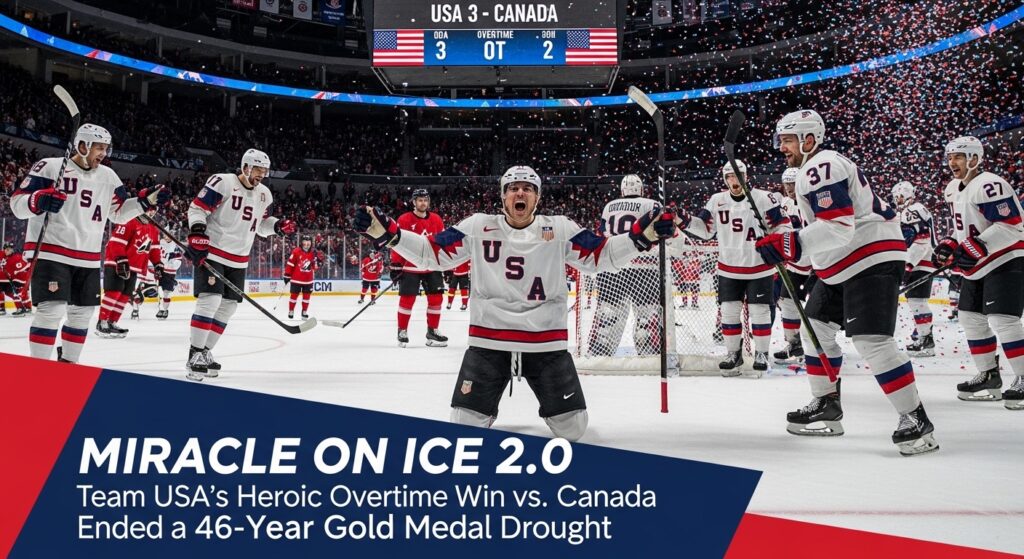
The atmosphere inside the PalaItalia was unlike anything seen in modern Olympic history. Fans from across the globe, many of whom had traveled from North America, created a cauldron of noise that vibrated through the skates of the players.
First Period: The Chess Match
The opening twenty minutes were a masterclass in defensive positioning. Both teams, aware of the stakes, played a cautious, high-tempo game. Team USA’s strategy was clear: neutralize Connor McDavid. Every time the Canadian captain touched the puck, he was shadowed by the relentless skating of Adam Fox or the physical presence of Brady Tkachuk.
At the other end, Canada’s defense, led by Cale Makar, was equally stingy. Auston Matthews had two quality looks from the high slot, but Canadian goaltender Adin Hill—who had been a pillar of strength throughout the tournament—turned them aside with clinical precision. The period ended 0-0, but the intensity suggested a storm was brewing.
Second Period: Canada Strikes First
The deadlock was finally broken midway through the second period. After a rare defensive lapse by the U.S. in the neutral zone, Nathan MacKinnon gained the zone and dropped a perfect pass to a trailing Connor Bedard. The 20-year-old superstar didn’t hesitate, rifling a snapshot into the top corner past Connor Hellebuyck.
The Canadian section of the arena erupted. For a moment, it felt like 2010 all over again. Canada had the lead, the momentum, and the world’s best players. Team USA looked rattled, struggling to sustain pressure as Canada’s forecheck intensified. Hellebuyck, however, kept the Americans in the game, making three spectacular saves on a Canadian power play to keep the deficit at one.
Third Period: The Matthews Moment
As the clock ticked down in the third period, the desperation in the American game became palpable. With less than eight minutes remaining, the U.S. finally found their opening. Quinn Hughes, the American captain, danced along the blue line, drawing two Canadian defenders toward him before threading a needle-point pass to Auston Matthews in the “Ovechkin spot.”
Matthews didn’t miss. His one-timer was a blur of black rubber that beat Hill before he could even react. The score was tied 1-1. The PalaItalia turned into a sea of red, white, and blue. The momentum had shifted, and for the final five minutes of regulation, the U.S. poured it on, nearly winning it in the final seconds when a Jack Hughes backhand rang off the post.
The Heroic Overtime: 2:43 of Pure Adrenaline
In the Olympics, the gold medal game overtime is played 5-on-5 for twenty minutes. It is the ultimate test of fitness, skill, and nerves. The tension was so thick it felt like it could be carved with a skate blade.
The overtime lasted exactly two minutes and forty-three seconds. It began with a frantic exchange of chances. McDavid nearly ended it on the first shift, weaving through the entire U.S. defense only to be denied by the outstretched pad of Hellebuyck.
Then came the moment that will be replayed in every American hockey montage for the next century.
Quinn Hughes gathered the puck behind his own net and spotted his brother, Jack, streaking through the neutral zone. A long, crisp stretch pass found Jack Hughes at the Canadian blue line. Jack used his elite edges to turn Cale Makar inside out, creating a 2-on-1 with Matthew Tkachuk. Instead of passing, Jack looked Hill in the eyes, faked a shot, and then tucked a backhand through the five-hole.
Silence for a microsecond, then pandemonium.
The “Miracle” Moniker: Comparing 1980 to 2026
The term “Miracle on Ice” is sacred in American sports. It refers to a group of college kids defeating the greatest professional hockey machine the world had ever seen. In 1980, the U.S. was a massive underdog, a David facing a Soviet Goliath.
In 2026, the context was different, but the emotional weight was identical. This wasn’t a group of amateurs; it was a collection of the world’s elite. Yet, the “Miracle” moniker fits because of the psychological barrier that had been built over forty-six years. For nearly half a century, the U.S. had been the “almost” team. They were the team that could win the World Juniors, the team that could dominate the World Championships, but the team that always seemed to blink when the Olympic gold was on the line against Canada.
The 2026 victory was a miracle of execution and mental fortitude. It was a miracle that a team could face the greatest collection of Canadian talent in history—a roster featuring three generational superstars in McDavid, MacKinnon, and Bedard—and refuse to break.
The Hellebuyck Wall
If Jack Hughes was the hero of the overtime, Connor Hellebuyck was the architect of the victory. His performance in the gold medal game was a masterclass in goaltending. Facing 42 shots from the most lethal offense in the world, Hellebuyck was a model of calm. His glove hand was a vacuum, and his rebound control was so precise it felt like he was playing a video game.
Hellebuyck’s performance was the ultimate validation of his career. A two-time Vezina winner, he had often been criticized for his playoff performances in the NHL. In Milan, he silenced every critic, proving that when the lights are brightest, he is the best in the world.
The Leadership of Quinn Hughes: A Captain’s Performance
When the U.S. roster was announced, there was some debate about who should wear the “C.” Names like Auston Matthews and Matthew Tkachuk were mentioned, but the coaching staff chose Quinn Hughes. It was a decision that paid dividends throughout the tournament.
Quinn Hughes didn’t just lead with his voice; he led with his play. His ability to control the pace of the game from the back end was the U.S.’s greatest weapon. In the final, he played a staggering 28 minutes, including nearly every second of the overtime. His vision on the winning goal—a pass that split the Canadian defense like a surgeon’s scalpel—was the culmination of a tournament where he was arguably the best defenseman on the planet.
The Canadian Perspective: A Bitter Pill to Swallow
For Canada, the loss was devastating. They had assembled what many considered the “Greatest Team Ever.” Connor McDavid, in his first Olympic appearance, was a force of nature, leading the tournament in scoring. Nathan MacKinnon was a wrecking ball, and Connor Bedard proved he is the heir apparent to the throne of hockey greatness.
Yet, for all their talent, Canada couldn’t find the final blow. The post-game images of McDavid staring at the American celebration, his silver medal hanging like a weight around his neck, will be the defining image of Canadian hockey for years to come. It was a reminder that in a single-elimination tournament, talent is only half the battle; the other half is luck, timing, and a hot goaltender.
The Impact on American Hockey: A New Era
The 2026 gold medal is more than just a trophy; it is a catalyst for the future of the sport in the United States. In the hours following the victory, social media was flooded with videos of young hockey players across America—from Minnesota to Florida—celebrating the win.
This victory does for the current generation what 1980 did for the previous one. It proves that the “American Way” of hockey—a focus on speed, skill, and high-IQ play—is a winning formula. The U.S. National Team Development Program (USNTDP), which produced nearly half the roster, has been vindicated on the world’s biggest stage.
The “Matthews Effect”
Auston Matthews’ role in this victory cannot be overstated. As the face of American hockey for the last decade, his commitment to the national team has been unwavering. His goal in the third period was the spark the U.S. needed, and his defensive play against McDavid was a revelation. Matthews has now cemented his legacy as the greatest American player to ever lace up skates.
Key Stats and Performers: By the Numbers
To truly appreciate the “Miracle on Ice 2.0,” one must look at the statistical dominance of the U.S. throughout the tournament.
| Player | Goals | Assists | Points | +/- |
|---|---|---|---|---|
| Jack Hughes | 5 | 7 | 12 | +8 |
| Auston Matthews | 6 | 4 | 10 | +6 |
| Quinn Hughes | 1 | 9 | 10 | +10 |
| Matthew Tkachuk | 3 | 5 | 8 | +4 |
| Adam Fox | 2 | 6 | 8 | +7 |
Goaltending Excellence
- Connor Hellebuyck: 5-0-0 record, 1.18 GAA, .962 SV%, 2 Shutouts.
- Jeremy Swayman: 1-0-0 record (Group stage win vs. Sweden).
The Atmosphere in Milan: A Global Celebration
The 2026 Winter Olympics were a triumph for Italy, and the hockey tournament was the crown jewel. The PalaItalia Santa Giulia, a state-of-the-art arena built specifically for the Games, was the perfect stage for this drama. The Italian fans, many of whom were new to the sport, were captivated by the speed and physicality of the best-on-best format.
The “Miracle on Ice 2.0” wasn’t just an American story; it was a global one. It was the return of the NHL to the world stage, a reminder of why hockey is the most exciting sport on earth. The quality of play in the final was so high that even the most casual observers were left in awe.
Conclusion: A Legacy Secured
As the American flag rose to the rafters of the PalaItalia and “The Star-Spangled Banner” played, the weight of forty-six years finally lifted. The 2026 U.S. Men’s Olympic Hockey Team didn’t just win a gold medal; they secured a legacy. They proved that the “Miracle” of 1980 wasn’t a fluke, but the beginning of a journey that has now reached its destination.
Jack Hughes, Auston Matthews, Quinn Hughes, and Connor Hellebuyck are now the names that will be spoken in the same breath as Mike Eruzione, Jim Craig, and Herb Brooks. They are the architects of the “Miracle on Ice 2.0,” the team that ended the drought and ushered in a new era of American hockey dominance.
The 46-year wait is over. The gold is back in the USA. And for the millions of fans who watched in the early hours of a February morning, the miracle is finally real again.
Final Thoughts for 2026 {#final-thoughts-2026}
As we look toward the 2030 Olympics in French Alps, the landscape of international hockey has been forever changed. The U.S. enters as the defending champions, the team to beat. The rivalry with Canada has reached a new, feverish pitch. But for now, the focus remains on the heroes of Milan. They did what many thought was impossible. They beat the best, to be the best.
Miracle on Ice 2.0. Believe it.